| Field | |
| Breakthroughs | Quantum teleportation • Quantum computing • Quantum propulsion systems |
| Future Potential | Extraordinary feats of interplanetary and interstellar exploration |
| Era of Advancements | Early 19th century to present |
| Technological Applications | Faster-than-light travel • In-depth mapping of solar system • Permanent human settlements on other planets and moons |
The understanding and application of quantum mechanics in this timeline has progressed at a far more rapid pace compared to our own reality, leading to revolutionary breakthroughs in space exploration and travel. Beginning with early pioneering work in the late 19th century, quantum theory has been at the forefront of scientific advancement, unlocking exotic new technologies that have radically transformed human capabilities beyond Earth's orbit.
Quantum physics first emerged as a distinct field of study in the 1880s, with groundbreaking experiments by scientists such as Max Planck, Hendrik Lorentz, and Wilhelm Röntgen that revealed the limitations of classical physics at the atomic and subatomic scales. Building upon this foundation, Albert Einstein's landmark 1905 paper on the photoelectric effect is widely regarded as the true birth of quantum theory.
In the decades that followed, the basic principles of quantum mechanics - including wave-particle duality, quantum entanglement, quantum tunneling, and the uncertainty principle - were rapidly developed and refined by physicists around the world. This rapid progress was driven in part by the immense potential applications of quantum phenomena, particularly in the realms of electronics, material science, and information technology.
The most transformative quantum breakthroughs, from the perspective of space travel and exploration, have been in the areas of quantum teleportation, quantum computing, and quantum propulsion. Beginning in the 1950s, scientists demonstrated the ability to teleport subatomic particles across increasingly large distances using quantum entanglement. This led to the development of practical quantum teleportation systems by the 1970s, enabling the instantaneous transfer of information and even physical objects between distant locations.
Quantum computing, emerging in the 1960s, provided unprecedented processing power for tasks like complex simulation, cryptanalysis, and navigation, which was essential for the planning and execution of ambitious space missions. The ability to model gravitational fields, celestial mechanics, and interplanetary trajectories with quantum computers revolutionized route planning and control systems for spacecraft.
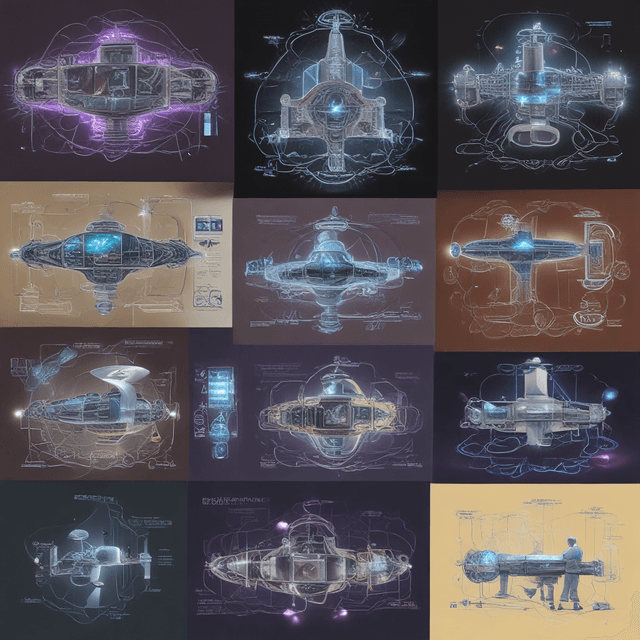
Perhaps most significantly, the 1980s saw the first breakthroughs in quantum propulsion - exotic new forms of spacecraft propulsion that leverage quantum phenomena to achieve faster-than-light travel. Technologies like quantum tunneling drives, quantum vacuum thrusters, and warp field generators have enabled rapid transit to the farthest reaches of the solar system and even interstellar travel.
These quantum technological leaps have dramatically accelerated the pace of space exploration and colonization. Robotic probes equipped with quantum sensors and teleportation systems have mapped the solar system in exquisite detail, while quantum-powered spacecraft have established permanent human settlements on the Moon, Mars, the Asteroid Belt, the Jovian moons, and even exoplanets.
Quantum computing networks coordinate these far-flung outposts, enabling real-time communication, resource management, and scientific collaboration across vast distances. Quantum-entangled communication channels also provide unhackable data transmission for sensitive information and mission-critical operations.
Despite these remarkable achievements, quantum physics still faces significant challenges when it comes to practical applications in space travel and exploration. Maintaining the delicate quantum states required for technologies like teleportation and propulsion remains an engineering hurdle, often requiring complex and energy-intensive systems. There are also lingering questions about the fundamental limits of quantum mechanics and whether even more exotic concepts like wormholes or traversable wormholes might be achievable.
Nonetheless, the trajectory of quantum physics research points to a future of even more extraordinary space exploration feats. Proposals for quantum space elevators, interstellar generation ships, and even quantum teleportation networks linking multiple solar systems are actively being studied. As our understanding of the quantum realm deepens, the boundaries of human expansion into the cosmos seem poised to be pushed ever further.
